Search This Blog

Showing posts with label University of Washington. Show all posts

Thursday, March 8, 2018

Going Public: Connecting Research & Community

Are you interested in involving community in your research process but uncertain where to start?  Do you already involve members of the public in your research process and would you like to connect with like-minded people around your experience?
Going Public event

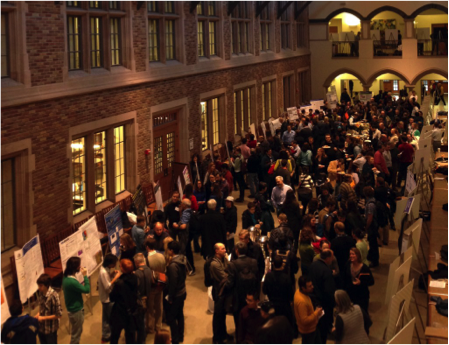
Join us on Saturday, April 7th from 9am-1pm for “Going Public: Connecting Research & Community” where we’ll explore engaging community in the research process through public scholarship, citizen science, community-engaged research, and participatory research. This interdisciplinary event offers an opportunity to expand your skills through several workshop offerings, to hear from researchers and community participants on their experiences through our “Research & Community Connections” panel presentation, and to see the different shapes this research can take through our graduate student poster display. For full details about our event including the schedule, please see the “Going Public: Connecting Research & Community” website.
This event is free and open to all: faculty, staff, graduate and undergraduate students, and community members from outside the university.  To ensure your space in our event, please register in advance. Registration will remain open until filled.

Wednesday, January 17, 2018

Data Science for Social Good Student Fellow applications are now open!


Are you interested in using data-driven discovery for societal benefit? 

The University of Washington eScience Institute, in collaboration with the Cascadia Urban Analytics Cooperative, is excited to announce the summer 2018 Data Science for Social Good (DSSG) program. The program brings together Student Fellows with data and domain researchers to work on focused, collaborative projects for societal benefit.
Sixteen DSSG Student Fellows will be selected to work with academic researchers, data scientists, and public stakeholder groups such as government officials, academic researchers, non-profit organizations, and the general public, on data-intensive research projects.
Who: Graduate students and advanced (junior/senior) undergraduate students are invited to apply. Spring 2018 graduates are eligible for this program. Students who are not U.S. citizens or permanent residents are eligible to apply as long as their visa status allows them to work in the U.S. We cannot sponsor student visas for this program.
What: Each student will be part of a team working full-time on a research project that has concrete relevance and impact. Students are expected to work closely and collaboratively with team members onsite for the duration of the 10-week program. Projects will have an applied social good dimension and involve analysis and visualization of data from areas such as public health, sustainable urban planning, environmental protection, disaster response, crime prevention, education, transportation, governance, commerce, and social justice. Click for summaries of projects from the Summer 2015 and Summer 2016  and Summer 2017 DSSG programs.
Where: Most work will be conducted on the UW campus in the WRF Data Science Studio, but some field excursions in the City of Seattle or King County may also be involved.
When: This is a 10-week long, full-time program beginning June 11th and ending August 17th 2018.
Compensation: Students will be given a stipend of $6,500 for the 10 weeks.
Desired qualifications:
·  Demonstrated experience in issues related to social good
·  Research experience with quantitative or qualitative tools
·  Strong academic record
·  Previous programming experience

How to Apply: CLICK HERE FOR THE APPLICATION FORMPlease note: a copy of your CV and unofficial transcripts are required to complete the form.
Questions may be directed to exec-director@escience.washington.edu.
Application Deadline: February 12th at midnight Pacific Time 

Tuesday, October 11, 2016

UW Hosting Trial of Data-Planet Statistical Datasets


UW librarians, faculty, and researchers are invited to learn more about the power of Data-Planet Statistical Datasets, the largest repository of standardized and structured data. We have trial access to this database along with the others listed at http://guides.lib.uw.edu/research/db-trial. 

Data-Planet founder Richard Landry will highlight subjects and sources covered, along with functionality, features, and visualization tools. You’ll leave with tips for searching, manipulating, and exporting data from over 70+ government and private sources, covering 35 billion data points in 4.9 billion datasets. 

Please register for the UW Libraries Data-Planet Statistical Datasets Webinar on Thursday, Oct 13, 2016 12:00 PM PDT at:  https://attendee.gotowebinar.com/register/1191767628182916610 
Participate remotely or join a group viewing of the webinar: Suzzallo Library, RAD. Thunderbird Conference Rm. (if you don’t work in the UW Libraries, contact cass@uw.edu for info about this location). 

Please visit  online for additional information: 

Please contact Cass Hartnett at cass@uw.edu or Marcy Rothman at mrothman@data-planet.com with any questions or special requests! 

After registering, you will receive a confirmation email containing information about joining the webinar. We look forward to hearing your feedback!

Thursday, September 15, 2016

Software Carpentry Workshop: Oct 10-13 @UWescience


Software Carpentry is a non-profit volunteer organization whose members teach researchers computing skills. 

On October 10th-13th, we will hold a four-day (mornings-only) Software Carpentry workshop at the UW eScience Data Science Studio. The workshop is focused on software tools to make researchers more effective, allowing them to automate research tasks, automatically track their research over time, and use programming to accelerate their research, and make it more reproducible.

In the workshop, we will have two parallel tracks: one in which we will focus on the programming language R, and the other in which we will focus on Python. 

For details, and to register for the upcoming workshop, please refer to the following web-page: https://uwescience.github.io/2016-10-10-uw/

Tuesday, March 29, 2016

Upcoming classes: Community Data Science Workshop, R + Stata

Several upcoming workshops and classes will be held Spring Quarter at the University of Washington, focusing on students needing R or Stata introductions, as well as another round of the popular Community Data Science Workshops. Details are below.

Classes

The Center for Social Science Computation and Research has posted their Spring Quarter classes, which includes Introduction to Stata, Introduction to R with R Studio, and Introduction to R with Commander. Students will learn basics software organization, where to find help, and how to get started with basic analyses. No previous experience in statistical programming is necessary, but basic understanding of statistics will be helpful. 

Workshops

The Spring 2016 round of the Community Data Science Workshops are for anyone interested in learning how to use programming and data science tools to ask and answer questions about online communities like Wikipedia, free and open source software, Twitter, civic media, etc. The Spring 2016 series consists of one Friday evening and three Saturday sessions in April and May. The workshops are for people with no previous programming experience and, thanks to sponsorship from eScience and the Department of Communication, are free of charge and open to anyone.

Our goal is that, after the three workshops, participants will be able to use data to produce numbers, hypothesis tests, tables, and graphical visualizations to answer questions like:

- Are new contributors to an article in Wikipedia sticking around   longer or contributing more than people who joined last year?

- Who are the most active or influential users of a particular Twitter hashtag?

- Are people who participated in a Wikipedia outreach event staying involved? How do they compare to people that joined the project outside of the event?

Details and dates are online here:

If you are interested in participating, please fill out our registration at the link above before Saturday April 2. Register soon!

If you already know how to program in Python, it would be really awesome if you would volunteer as a mentor! Being a mentor involves working with participants and talking them through the challenges they encounter in programming. No special preparation is required. If you’re interested, there’s a link on the page above, or you can send me an email. If you mentored before, it’s still easier if you fill our form again. Thanks!

Regards,
Mako (On behalf of Jonathan, Tommy, Dharma, Ben, Mika, and all the CDSW
mentors.)


Wednesday, March 23, 2016

Next Week! Digital Scholarship Focus Groups

In an effort to develop our digital scholarship program in the Libraries, we will be holding a series of focus groups with faculty and graduate students working in the sciences. Goals of the focus groups are to determine what types of digital scholarship research and teaching is currently being done in departments across campus and to determine what types of barriers (if any) exist in completing digital scholarship work. If you are working on digital projects or data visualization, we would love to hear from you! Faculty focus groups are March 29: 12:30-1:15pm, March 30: 10:30-11:15am. Graduate student focus groups are March 29: 10:30-11:15am, March 29: 2:30-3:15pm. You may sign up for focus groups here. We'll confirm your participation, send you the location and a list of a few questions we'll cover to help start the conversation.  Light refreshments will be provided for participants.

Thank you for your participation! Questions can be directed to Verletta Kern, our Digital Scholarship Librarian.

Wednesday, January 20, 2016

UW Data Science Poster and Networking Session - Register now!


Are you engaged in research or teaching involving data-intensive discovery — either advancing the methodologies, or putting these methodologies to work in any field of discovery?  Does your work require extracting knowledge from large, noisy, or complex datasets? Do you use advanced statistical techniques, advanced data management platforms, or advanced visualization methods in your work? Are you involved in inventing these advanced methods? If so, please register to present your work in this poster session!

This two-hour event is an opportunity for the University of Washington campus community and regional partners to present their activities and connect with others engaged in data-intensive discovery.

Date: Feb 10, 2016 | 3:00 pm – 5:00 pm

Location: Mary Gates Commons

Refreshments will be provided for all attendees … the costs of poster production will be covered … easels will be provided … how can you say no?

This is an incomparable opportunity to network with others who are advancing the forefront of data-intensive discovery.
  • Posters must be roughly 32″ x 40″
  • Posters must be mounted on posterboard or foamcore (easels will be provided for displaying them – they will not be tacked to the wall)
  • You must be present at the poster session (although you’re encouraged to bring someone along so you can simultaneously staff your poster and network with others)
  • You must register by Wednesday February 3
Various off-campus printshops (e.g., FedEx) can assist, as well as UW Creative Communications, UW Posters (in the Health Sciences), and (for their members) many major departments. Save your receipts – we’ll reimburse your expenses up to $100!

Please register here by Wednesday February 3rd to present a poster!
We’ll see you on February 10 at 3:00pm (setup beginning at 1:00pm) in the Mary Gates Commons!

Questions? Contact manager@escience.washington.edu

Monday, April 27, 2015

Upcoming data speakers on UW Campus

Several upcoming speakers on the UW campus will be of interest to local data folks:
  • Tuesday, April 28 @ 1:30, Data Science Studio, 6th floor Physics/Astronomy Tower. Tony Hey will speak on Physics and Computing: Open Science Decoded. Abstract: "The talk will start with the OSTP memo on open access, and then go on to discuss executable papers and best practice for reproducibility of computational physics research. After looking at computing for Big Physics (e.g. the ATLAS collaboration at the CERN LHC), for Medium-scale Physics (with the UK's Collaborative Computational Projects), and for Long Tail Physics, the paper ends with some comments about open source, scientific software quality and career paths for scientific software developers."
  • Wednesday, April 29 @ 2pm, Allen Auditorium, Allen Library. Data Librarian Jenny Muilenburg will address Data Management Plans: Reading, Writing, and Sharing. Topics will include some of the different agency requirements around DMPs, some local resources to help create DMPs, and some examples from different disciplines.
  • Wednesday, April 29 @ 3:30pm, Data Science Studio. Cesar Hidalgo from the MIT Media Lab, Why Information Grows: The Evolution of Order, from Atoms to Economies. Abstract: "The universe is made of energy, matter and information; but information is what makes the universe interesting. Without information, the universe would lack the shapes, structures, and order that gives the universe both its beauty and complexity. But where does information comes from and what are the natural, social, and economic mechanisms that help information grow? In this talk I will describe the growth of physical order—or information—from atoms to economies by explaining the physical mechanisms that allow order to exist, and the social and economic mechanisms that allow order to prevail in our society and economy."
  • Tuesday, May 5 @ 4pm, Data Science Studio. There will be an Integrative Graduate Education and Research Traineeship (IGERT)Info Session and Reception, useful for those wanting to know more about the Big Data IGERT PhD fellowship or the PhD program. Brief presentations from several IGERT students on current research will be features, as well as a Q&A session.


Tuesday, February 3, 2015

UW All-Campus Reproducibility Seminar: 2/10 @ 1:30pm

Ben Marwick, Assistant Professor of Archaeology, joins the All-Campus Reproducibility Seminar Series on February 10 at 1:30pm in the WRF Data Science Studio Meeting Room, 6th floor Physics/Astronomy Tower. He will give a talk titled: 

"Doing Reproducible Research with Docker"

Abstract:

A key obstacle to reproducible research that I frequently encounter when working with students and collaborators is keeping the toolkit simple, with managing dependencies being an especially time-consuming challenge. Virtual machines are one solution to these problems, but remain less than ideal because of relatively long start-up and shut-down times, their large size and performance demands, limited portability, and the need for the user to be familiar with a different desktop environment, amongst other concerns. In this talk I introduce Docker, a free and open source Linux container tool recently popular amongst commercial DevOps workers that provides lightweight virtual environments on Windows/OSX/Linux systems and has several advantages over regular virtual machines. I will describe the key elements of doing reproducible research with Docker and demonstrate dockerfiles, containers, images and registries (bring your laptop and follow along! If your using Windows/OSX then be sure to install http://boot2docker.io/ in advance). I will show how these help with dependencies and keeping things simple, especially when working with R or Python.

Please join us!